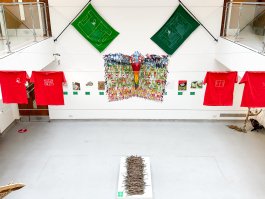
Walking and Talking with Landscape: The Curlew Way, PR1 Gallery, Preston, October 2025, installation shot
One of the first times I met William Titley, he gave an impression of the curlew, approximating its eerie, high pitched rising trill as he explained why this wading bird holds such a fascination for him.
Although many people would fail to recognise one, the curlew is one of Britain’s most distinctive birds, with a long, slender, slightly curved beak which seems to extend and taper out of all proportion to its body. William’s interest in the curlew, and its place in the county’s environmental, cultural and social heritage, has taken him on an epic, 62-mile walk across the breadth of Lancashire, from his industrial home town of Colne, inland in the Pennine hills, through the nationally protected landscape of the Forest of Bowland to the marshy tidal expanses of Morecambe, on the coast.
Along the way, William has created a series of birdwatching videos. Wrapped up against the cold and wind of a Lancashire winter, squelching through muddy fields and along windswept paths, the viewer has been able join him from the comfort of their own home as he seeks the first signs of the curlew in the spring and follows them through nesting, breeding and hatching. These short films have both a slowness and a rhythm to them: the curlew takes us through the seasons, and across landscapes and terrains, connecting us emotionally and temporally with the world and environment around us.
The Curlew Way has something in common with citizen science, tapping into a 20th century tradition of amateur observation and nature-watching. This began around a hundred years ago, with the ‘new ornithology’ movement, which invited geographically dispersed amateur observers to contribute to a collective record of birdlife. It continues to this day through projects such as the RSPB’s Big Garden Birdwatch, in which hundreds of thousands of people participate every year. By returning to likely locations year on year the Curlew Way, too, is adding to a rich source of data compiled through everyday, local observation and knowledge.
William invited others to join him in observation and conversation as he traced the curlew’s migratory path, creating an important point of connection both with others and with nature. This feels particularly significant as, in 2025, the Guardian reported that Britain is one of the least ‘nature-connected’ countries in the world, with citizens experiencing a lower level of connectedness to other species than those in most other countries. Access to the nature and the countryside is unequal, depending upon a number of factors, from ethnic and religious background and cultural familiarity to availability of transport; in spite of its close proximity to natural beauty, these issues are felt particularly acutely in Pennine Lancashire. The Curlew Way has sparked discussion not just about what those participating in the walks saw on the day, but broader reflections on access to landscape and nature, and its benefits for mental health and wellbeing.

Walking and Talking with Landscape: The Curlew Way, PR1 Gallery, Preston, October 2025, installation shot
A composite film created from documentation of these walks shows the breath-taking variety of landscapes in Lancashire: exposed, elevated moorland, forest, farmed land and fields, wildflower meadows, rocky beaches and the wide-open skies of the coast. It also highlights the different ways in which people relate to the land: landscape is shown to be habitat, historical site and workplace, but also a site for leisure, enjoyment and education.
Landscape, environment and nature have a complex and intertwined relationship in Lancashire: both agriculture and industry have left their mark. The area’s climatic and geographic features enabled industrialisation – which in turn transformed the landscape and environment. The curlew migrates according to its need to breed or seek sources of food and the human population, too, has shifted through patterns of migration – from other areas of the country in search of work as Lancashire industrialised in the 19th century, then from other areas of the world in the second half of the 20th century (and in more recent decades recently outwards again, in the case of many young people, towards the bright lights and employment opportunities of London and the South East). The Curlew Way has followed a network of footpaths forged through these economic, cultural and social influences, relating to ancient field patterns, but also trading routes, pathways to places of religious worship or well-worn but now redundant cut-throughs to the mills which once dominated employment in the area.
Farming practices and industrialisation alike have been destructive to Britain’s landscapes and wildlife populations. In 2023, the State of Nature report found that the UK was one of the world’s most nature-depleted countries: almost half of its species have been lost, with many more facing extinction. The curlew is one of the species on Britain’s ‘red’ list of endangered birds: its habitats are at risk from a range of factors, from housing development and litter on a hyperlocal level, to farming methods and climate change on national and global scales.
This is not helped by political attitudes and policies towards nature: the current Labour government’s reforms to the planning system prioritise development and growth over protection of the natural environment. These debates and contradictions are felt keenly in places such as Colne, on the periphery of the urban and the rural, where residents have mobilised against repeated attempts to build on the Upper Rough, one of the sites used by nesting curlews.
The Curlew Way shares a concern for care and community action with much of William’s past work, alongside an approach that involves working with local people in place over a period of time. Previous projects have used the practices of walking and talking to explore history, memory and identity, and connect local heritage with contemporary social issues. ‘Waterside’ (1998-2004), for example, involved the performative mapping of a village in Lancashire lost to slum clearance in the 1930s. ‘Demolition Street’ (2004-2017) saw parallels with this process in the Housing Market Renewal Scheme of the 2000s, a controversial government programme to regenerate the local housing market, creating an archive of interviews, prints, photographs and found objects documenting a street in Colne scheduled to be demolished. In 2018-2019, the film ‘[birdsong]’ brought together communities in Pendle to remember and reimagine the classic 1961 film Whistle Down the Wind, which was filmed around Pendle Hill, celebrate the area’s natural beauty and make connections with new social issues.

Walking and Talking with Landscape: The Curlew Way, PR1 Gallery, Preston, October 2025, installation shot
A powerful spur to action in the Curlew Way has been through involvement with a local school, Colne Park High. The project could be seen as an intervention into the ongoing debate about the nature and purpose of education – is it to impart skills, facts and knowledge, or is it to create rounded citizens capable of thinking and acting for themselves (or a mixture of both)?
The Curlew Way shows the potential for the artist to work as an educator in tandem with the natural environment, with William acting as facilitator for children’s skills of observation and creativity. In this regard, the Curlew Way echoes mid-20th century experiments in art education, which argued that everyone was – or had the potential to be – an artist and saw inherent value in children’s way of seeing the world and expressing themselves. It could also be seen as reviving a seam of nature education which sought to actively involve children in their learning and local environments through participation and local observation, from the Land Utilisation Survey of the 1930s, for which hundreds of thousands of schoolchildren mapped their local parishes, to an interwar enthusiasm for building collaborative models of local areas around schools, to the creation of ‘pocket museums’ in classrooms in the 1960s and 1970s displaying objects picked up by children. Now that much learning is standardised across the country through the National curriculum, campaigners continue to make the case for locally rooted learning and an education that connects young people to the natural world outside the schoolroom; examination board Cambridge OCR is currently working to introduce a new GCSE in Natural History.
Working with a small group of around a dozen pupils, William has taken students on field trips to different locations in Lancashire, from Morecambe and the Forest of Bowland to a working farm and breeding sites local to the school. Sketchbook pages from these visits show the value of spending time in landscape, looking, listening and watching. Students’ sketches and notes demonstrate learned knowledge and information about landscape and nature – for example curlews’ habitats, lifecycles and predators – but there is also space for the affective aspects of landscape. Literal qualities, such as the objects and colours that one can see in pictures or videos, are highlighted alongside the atmospheric experience that only comes from being in a place: it’s relaxing, quiet, peaceful and still, but also fragile. Students remind us that landscape is in a process of becoming: the tide goes in and out, and lapping waves wash rocks upon the shore, but it is also shaped by farming and other human activities, from traffic and train travel to dog-walking.
On returning to the classroom, pupils were invited to create artworks in response to their observations. Many of these make clever use of materials, particularly human detritus and waste products. This includes incorporating newsprint as collage material, highlighting the ways in which the media influences our understandings and awareness of nature and activism. Other artworks carefully arrange found objects such as litter and rocks. Teetering in delicate balance, they evoke the fragile ecosystem on which birds such as the curlew depend and decry the way in which the natural world has been spoiled by humans.
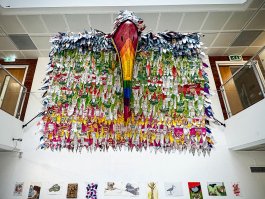
With its buff colouring, the curlew tends to blend into its environment and is therefore easily missed by those who don’t know what they are looking for. William has created a wearable costume from garish green, pink and blue crisp and sweet packets, which transforms the usually low-key figure of the bird into something highly visible. At the same time, the piece imagines a future bio-plastic species and reminds the viewer that microplastics have permeated every aspect of our environments, including our bodies.

Walking and Talking with Landscape: The Curlew Way, PR1 Gallery, Preston, October 2025, installation shot
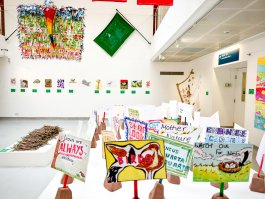
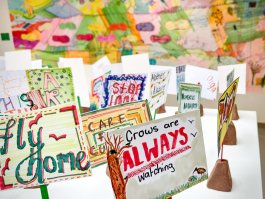
These artworks emphasise individual responsibility towards the environment, highlighting local problems such as litter dropping, in ways that are both subtle and overt. Other artworks created by the group are more explicitly political. A collective piece, ‘Plant Pot Protest’, places postcards on recycled lolly sticks. Designed to be placed in plant pots at home or around the school, they bear messages such as ‘Stop pollution’, ‘Fly away home’ and ‘Watch your step’. These short declarations and commands show the power of words, as well as emphasising the need for care of environments and non-human life.
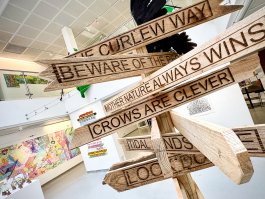
The group also created a series of hand-painted designs for waymarking signs. Subsequently translated into a wooden signpost using recycled pallets, the post points in multiple directions, bearing messages that range from the whimsical and reflective to the factual, instructive and cautionary: ‘We are the predators’; ‘Always looking for a forever home’; ‘Mother nature always wins’; ‘Curlew crossing!!!’; ‘Careful where you tread, curlews ahead’; ‘Look down’; ‘Beware of the people’. This impulse towards waymarking encapsulates one of the key messages of the Curlew Way: we are used to humans managing the landscape and signposting people towards nature, yet paying attention to the curlew and its migratory patterns shows how nature can signpost us, guiding us through places and teaching us how to tune in to the seasons.
In addition to instructing visitors about how to behave in landscape, these collectively created artworks link the Curlew Way back to earlier histories of protest and activism relating to access to the land. They acknowledge that walking, and accessing landscape, is a political and cultural act. Most famously, the Kinder Trespass of 1932 won the right to roam in the Peak District, in between the great industrial cities of Sheffield and Manchester, yet battles over footpaths remain: in recent years, the ‘Don’t Lose Your Way’ campaign, run by national charity the Ramblers, has enlisted walkers to save public rights at way at risk of being lost.
Artworks created with Colne Park High School have been incorporated into new maps plotting walking routes across Lancashire. However, they’re not to scale: they offer a highly subjective view of place and landscape that charts sensory, impressionistic, emotive paths across the county rather than prioritising topographical accuracy.

Walking and Talking with Landscape: The Curlew Way, PR1 Gallery, Preston, October 2025, installation shot
The story of the Curlew Way concludes with a twist in its tail; during the project, it emerged that Colne Park High School is itself is home to a rich wildlife habitat. Filming and photographing the site revealed that the sports fields support six red endangered species and six amber listed species, including the curlew, as well as an ecosystem of insects and bats. Since commencing the project, however, the trust that operates the school (along with other local schools) has applied to replace the existing facilities with all-weather facilities. This includes the installation of an artificial sports pitch, despite the well-documented drawbacks of artificial turf, from microplastic pollution to the loss of biodiversity and natural habitats.
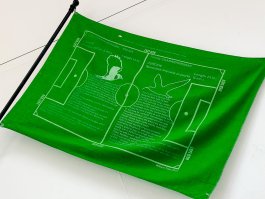
William lays bare the tension between sports amenity and habitat in the piece ‘Match Fit #1’. Taking the form of a screenprint on a recycled Subbuteo pitch, using factual information drawn from a 1930s edition of The Observer Book of British Birds by S Vere Benson, it juxtaposes the curlew’s habitat with the highly controlled environment of the sports field, pitting the curlew against the lapwing and man against nature. The colourful expanse of fabric could be a football fan’s flag, unfurled to express support for a team and designed to stand out among the vast crowds of a football stadium. Draped from a flagpole, it resembles a banner like those taken on protest marches (a new campaign group, the Pitch Protestors, has been formed to contest the plans).
The Curlew Way demonstrates nature’s ability to make citizens and activists of us, as protectors of the natural world and its relationship to the human and non-human. It invites us to make connections with other people, places and forms of life, and asks us to play an active part in our local landscapes and environments. The project has brought together disparate people and places, from experts and agriculturalists to amateurs, enthusiasts and young people, across a range of terrains from the Pennines to the coast, and shows how local issues and places are interlinked with bigger ecologies.

Walking and Talking with Landscape: The Curlew Way, PR1 Gallery, Preston, October 2025, installation shot
Commissioned by William Titley for the publication The Curlew Way: Walking & Talking with Landscape, published July 2026
Explore William's YouTube channel the Curlew Way

Walking and Talking with Landscape: The Curlew Way, PR1 Gallery, Preston, October 2025, installation shot
One of the first times I met William Titley, he gave an impression of the curlew, approximating its eerie, high pitched rising trill as he explained why this wading bird holds such a fascination for him.
Although many people would fail to recognise one, the curlew is one of Britain’s most distinctive birds, with a long, slender, slightly curved beak which seems to extend and taper out of all proportion to its body. William’s interest in the curlew, and its place in the county’s environmental, cultural and social heritage, has taken him on an epic, 62-mile walk across the breadth of Lancashire, from his industrial home town of Colne, inland in the Pennine hills, through the nationally protected landscape of the Forest of Bowland to the marshy tidal expanses of Morecambe, on the coast.
Along the way, William has created a series of birdwatching videos. Wrapped up against the cold and wind of a Lancashire winter, squelching through muddy fields and along windswept paths, the viewer has been able join him from the comfort of their own home as he seeks the first signs of the curlew in the spring and follows them through nesting, breeding and hatching. These short films have both a slowness and a rhythm to them: the curlew takes us through the seasons, and across landscapes and terrains, connecting us emotionally and temporally with the world and environment around us.
The Curlew Way has something in common with citizen science, tapping into a 20th century tradition of amateur observation and nature-watching. This began around a hundred years ago, with the ‘new ornithology’ movement, which invited geographically dispersed amateur observers to contribute to a collective record of birdlife. It continues to this day through projects such as the RSPB’s Big Garden Birdwatch, in which hundreds of thousands of people participate every year. By returning to likely locations year on year the Curlew Way, too, is adding to a rich source of data compiled through everyday, local observation and knowledge.
William invited others to join him in observation and conversation as he traced the curlew’s migratory path, creating an important point of connection both with others and with nature. This feels particularly significant as, in 2025, the Guardian reported that Britain is one of the least ‘nature-connected’ countries in the world, with citizens experiencing a lower level of connectedness to other species than those in most other countries. Access to the nature and the countryside is unequal, depending upon a number of factors, from ethnic and religious background and cultural familiarity to availability of transport; in spite of its close proximity to natural beauty, these issues are felt particularly acutely in Pennine Lancashire. The Curlew Way has sparked discussion not just about what those participating in the walks saw on the day, but broader reflections on access to landscape and nature, and its benefits for mental health and wellbeing.

Walking and Talking with Landscape: The Curlew Way, PR1 Gallery, Preston, October 2025, installation shot
A composite film created from documentation of these walks shows the breath-taking variety of landscapes in Lancashire: exposed, elevated moorland, forest, farmed land and fields, wildflower meadows, rocky beaches and the wide-open skies of the coast. It also highlights the different ways in which people relate to the land: landscape is shown to be habitat, historical site and workplace, but also a site for leisure, enjoyment and education.
Landscape, environment and nature have a complex and intertwined relationship in Lancashire: both agriculture and industry have left their mark. The area’s climatic and geographic features enabled industrialisation – which in turn transformed the landscape and environment. The curlew migrates according to its need to breed or seek sources of food and the human population, too, has shifted through patterns of migration – from other areas of the country in search of work as Lancashire industrialised in the 19th century, then from other areas of the world in the second half of the 20th century (and in more recent decades recently outwards again, in the case of many young people, towards the bright lights and employment opportunities of London and the South East). The Curlew Way has followed a network of footpaths forged through these economic, cultural and social influences, relating to ancient field patterns, but also trading routes, pathways to places of religious worship or well-worn but now redundant cut-throughs to the mills which once dominated employment in the area.
Farming practices and industrialisation alike have been destructive to Britain’s landscapes and wildlife populations. In 2023, the State of Nature report found that the UK was one of the world’s most nature-depleted countries: almost half of its species have been lost, with many more facing extinction. The curlew is one of the species on Britain’s ‘red’ list of endangered birds: its habitats are at risk from a range of factors, from housing development and litter on a hyperlocal level, to farming methods and climate change on national and global scales.
This is not helped by political attitudes and policies towards nature: the current Labour government’s reforms to the planning system prioritise development and growth over protection of the natural environment. These debates and contradictions are felt keenly in places such as Colne, on the periphery of the urban and the rural, where residents have mobilised against repeated attempts to build on the Upper Rough, one of the sites used by nesting curlews.
The Curlew Way shares a concern for care and community action with much of William’s past work, alongside an approach that involves working with local people in place over a period of time. Previous projects have used the practices of walking and talking to explore history, memory and identity, and connect local heritage with contemporary social issues. ‘Waterside’ (1998-2004), for example, involved the performative mapping of a village in Lancashire lost to slum clearance in the 1930s. ‘Demolition Street’ (2004-2017) saw parallels with this process in the Housing Market Renewal Scheme of the 2000s, a controversial government programme to regenerate the local housing market, creating an archive of interviews, prints, photographs and found objects documenting a street in Colne scheduled to be demolished. In 2018-2019, the film ‘[birdsong]’ brought together communities in Pendle to remember and reimagine the classic 1961 film Whistle Down the Wind, which was filmed around Pendle Hill, celebrate the area’s natural beauty and make connections with new social issues.

Walking and Talking with Landscape: The Curlew Way, PR1 Gallery, Preston, October 2025, installation shot
A powerful spur to action in the Curlew Way has been through involvement with a local school, Colne Park High. The project could be seen as an intervention into the ongoing debate about the nature and purpose of education – is it to impart skills, facts and knowledge, or is it to create rounded citizens capable of thinking and acting for themselves (or a mixture of both)?
The Curlew Way shows the potential for the artist to work as an educator in tandem with the natural environment, with William acting as facilitator for children’s skills of observation and creativity. In this regard, the Curlew Way echoes mid-20th century experiments in art education, which argued that everyone was – or had the potential to be – an artist and saw inherent value in children’s way of seeing the world and expressing themselves. It could also be seen as reviving a seam of nature education which sought to actively involve children in their learning and local environments through participation and local observation, from the Land Utilisation Survey of the 1930s, for which hundreds of thousands of schoolchildren mapped their local parishes, to an interwar enthusiasm for building collaborative models of local areas around schools, to the creation of ‘pocket museums’ in classrooms in the 1960s and 1970s displaying objects picked up by children. Now that much learning is standardised across the country through the National curriculum, campaigners continue to make the case for locally rooted learning and an education that connects young people to the natural world outside the schoolroom; examination board Cambridge OCR is currently working to introduce a new GCSE in Natural History.
Working with a small group of around a dozen pupils, William has taken students on field trips to different locations in Lancashire, from Morecambe and the Forest of Bowland to a working farm and breeding sites local to the school. Sketchbook pages from these visits show the value of spending time in landscape, looking, listening and watching. Students’ sketches and notes demonstrate learned knowledge and information about landscape and nature – for example curlews’ habitats, lifecycles and predators – but there is also space for the affective aspects of landscape. Literal qualities, such as the objects and colours that one can see in pictures or videos, are highlighted alongside the atmospheric experience that only comes from being in a place: it’s relaxing, quiet, peaceful and still, but also fragile. Students remind us that landscape is in a process of becoming: the tide goes in and out, and lapping waves wash rocks upon the shore, but it is also shaped by farming and other human activities, from traffic and train travel to dog-walking.
On returning to the classroom, pupils were invited to create artworks in response to their observations. Many of these make clever use of materials, particularly human detritus and waste products. This includes incorporating newsprint as collage material, highlighting the ways in which the media influences our understandings and awareness of nature and activism. Other artworks carefully arrange found objects such as litter and rocks. Teetering in delicate balance, they evoke the fragile ecosystem on which birds such as the curlew depend and decry the way in which the natural world has been spoiled by humans.
With its buff colouring, the curlew tends to blend into its environment and is therefore easily missed by those who don’t know what they are looking for. William has created a wearable costume from garish green, pink and blue crisp and sweet packets, which transforms the usually low-key figure of the bird into something highly visible. At the same time, the piece imagines a future bio-plastic species and reminds the viewer that microplastics have permeated every aspect of our environments, including our bodies.

Walking and Talking with Landscape: The Curlew Way, PR1 Gallery, Preston, October 2025, installation shot
These artworks emphasise individual responsibility towards the environment, highlighting local problems such as litter dropping, in ways that are both subtle and overt. Other artworks created by the group are more explicitly political. A collective piece, ‘Plant Pot Protest’, places postcards on recycled lolly sticks. Designed to be placed in plant pots at home or around the school, they bear messages such as ‘Stop pollution’, ‘Fly away home’ and ‘Watch your step’. These short declarations and commands show the power of words, as well as emphasising the need for care of environments and non-human life.
The group also created a series of hand-painted designs for waymarking signs. Subsequently translated into a wooden signpost using recycled pallets, the post points in multiple directions, bearing messages that range from the whimsical and reflective to the factual, instructive and cautionary: ‘We are the predators’; ‘Always looking for a forever home’; ‘Mother nature always wins’; ‘Curlew crossing!!!’; ‘Careful where you tread, curlews ahead’; ‘Look down’; ‘Beware of the people’. This impulse towards waymarking encapsulates one of the key messages of the Curlew Way: we are used to humans managing the landscape and signposting people towards nature, yet paying attention to the curlew and its migratory patterns shows how nature can signpost us, guiding us through places and teaching us how to tune in to the seasons.
In addition to instructing visitors about how to behave in landscape, these collectively created artworks link the Curlew Way back to earlier histories of protest and activism relating to access to the land. They acknowledge that walking, and accessing landscape, is a political and cultural act. Most famously, the Kinder Trespass of 1932 won the right to roam in the Peak District, in between the great industrial cities of Sheffield and Manchester, yet battles over footpaths remain: in recent years, the ‘Don’t Lose Your Way’ campaign, run by national charity the Ramblers, has enlisted walkers to save public rights at way at risk of being lost.
Artworks created with Colne Park High School have been incorporated into new maps plotting walking routes across Lancashire. However, they’re not to scale: they offer a highly subjective view of place and landscape that charts sensory, impressionistic, emotive paths across the county rather than prioritising topographical accuracy.

Walking and Talking with Landscape: The Curlew Way, PR1 Gallery, Preston, October 2025, installation shot
The story of the Curlew Way concludes with a twist in its tail; during the project, it emerged that Colne Park High School is itself is home to a rich wildlife habitat. Filming and photographing the site revealed that the sports fields support six red endangered species and six amber listed species, including the curlew, as well as an ecosystem of insects and bats. Since commencing the project, however, the trust that operates the school (along with other local schools) has applied to replace the existing facilities with all-weather facilities. This includes the installation of an artificial sports pitch, despite the well-documented drawbacks of artificial turf, from microplastic pollution to the loss of biodiversity and natural habitats.
William lays bare the tension between sports amenity and habitat in the piece ‘Match Fit #1’. Taking the form of a screenprint on a recycled Subbuteo pitch, using factual information drawn from a 1930s edition of The Observer Book of British Birds by S Vere Benson, it juxtaposes the curlew’s habitat with the highly controlled environment of the sports field, pitting the curlew against the lapwing and man against nature. The colourful expanse of fabric could be a football fan’s flag, unfurled to express support for a team and designed to stand out among the vast crowds of a football stadium. Draped from a flagpole, it resembles a banner like those taken on protest marches (a new campaign group, the Pitch Protestors, has been formed to contest the plans).
The Curlew Way demonstrates nature’s ability to make citizens and activists of us, as protectors of the natural world and its relationship to the human and non-human. It invites us to make connections with other people, places and forms of life, and asks us to play an active part in our local landscapes and environments. The project has brought together disparate people and places, from experts and agriculturalists to amateurs, enthusiasts and young people, across a range of terrains from the Pennines to the coast, and shows how local issues and places are interlinked with bigger ecologies.

Walking and Talking with Landscape: The Curlew Way, PR1 Gallery, Preston, October 2025, installation shot
Commissioned by William Titley for the publication The Curlew Way: Walking & Talking with Landscape, published July 2026
Explore William's YouTube channel the Curlew Way