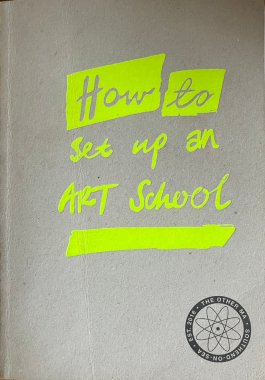
Established in Southend in 2016, and run as an artist-led co-operative, the founders of The Other MA (TOMA) see the project not only as an alternative art school but also as a continual – though precarious – artwork. It is fitting, therefore, that How to Set Up an Art School, a new publication documenting the school as it nears its tenth anniversary, is both an art object and an invitation to others to take up the mantle of non-mainstream art education. Produced at a pivotal time as TOMA’s founder – artist Emma Edmondson – steps back, the publication offers critical reflection as well as practical advice.
The book is characterised by a feeling of openness and transparency. Its designer, former student Lu Williams, references textbooks by underlining and circling key words and leaving space at the end (styled alternately like graph paper and a ruled notebook) for the reader to make notes. The completeness with which the project is documented gives a sense of generosity: the book gathers materials that might act as guides or templates, reproducing in full documents such as notes, budgets, a year plan, a template for crit notes, access and inclusion documents, a student card and TOMA’s payment policy/rate card.
If this level of detail makes TOMA sound like a slick, professional operation, the book owes as much to punk and DIY traditions as bureaucratic institutions: an irreverently styled sausage on a stick, designed by the artist Bruce McLean (who also funded the book, Interview AM66), which is presented to students in place of a traditional graduation certificate, gives a particularly good sense of TOMA’s ethos.
Whereas other recent publications have overly academicised alternative art schools (Reviews AM481), How to Set Up an Art School keeps theory to a minimum. Rather than aping academic language, TOMA’s organisers conceptualise what they’re doing in their own, vividly descriptive way. Edmondson has previously compared TOMA, and the way in which it collaborates with other small arts organisations within its local ecosystem, with lichen, which entails a symbiotic relationship between fungus and algae (Reports AM443). TOMA’s policies, meanwhile, are inspired by cornstarch, a substance which, when mixed with water, can be both solid and fluid, immovable and responsive. Another powerful recurring metaphor is the itch: itching involves asking difficult questions, going against the norm, questioning systems and policies and rebelling against conventional art school models.
Activism runs through the book. The starting point is the 2008 financial crisis and the backdrop of austerity, against which Edmondson’s own journey through the higher education system to becoming a practising artist took place. The ConDem coalition government’s 2010 reforms to higher education, which included the trebling of tuition fees in 2012, was clearly a pivotal point for Edmondson. The political context remains key: since then, the availability of education and employment in the arts has only worsened. TOMA responds to this by providing opportunities for those who may otherwise be unable to access art education and the book is strong on the practicalities of making a living as an artist: lessons include write funding applications, drafting proposals and filing tax returns.
While Edmondson’s experiences remain central, How to Set Up an Art School brings together representatives of other alternative education projects for debate and discussion. Most importantly, space is also made for student voices, and this includes documenting artworks created as part of the programme. Slippery when worn, 2024, by Fern Worsley, is a wearable artwork which directly incorporates notes from TOMA sessions. Like TOMA itself, which continues to evolve with the needs and interests of each cohort, the garment is designed to be flexible. Also included is a series of works commissioned from students as aids to evaluation. All mixed up together like bees in a hive, 2024, an A4 worksheet by Neeral Bhatt, comprises a series of interlocking hexagons that invite the user to forge connections and relationships between words such as ‘grow’, ‘experiment’, ‘collaborate’, dream’ and ‘support’.
How to Set Up an Art School directly addresses anyone who might be wondering where to begin when organising an alternative to mainstream art education. The book prompts the reader to approach the challenge from two opposing viewpoints, asking ‘What is the worst reason you could have for setting up an art school?’ and, conversely, ‘What is the best reason you could have for setting up an art school?’. The book suggests that there is no one-size-fits-all model; instead, it provides tools to support and interrogate the motivations and practices of those trying to find different ways of operating outside the (now crumbling) expansionist, profit-driven university system.
Originally published in Art Monthly, November 2025
How to Set Up an Art School, The Other MA (TOMA), 2025, 244pp, pay what you can (£0-45), 978 1 068216 80 0.